How to Establish Shared Values in Early Marriage

Shared values in marriage are defined as the core beliefs and priorities that two partners consciously agree to build their life around. Couples who establish shared values early in marriage create a decision-making framework that reduces conflict, builds trust, and deepens emotional connection over time. Love alone is not enough to sustain a marriage through real challenges. Clarity about each other's internal world creates the emotional safety needed to negotiate differences before they become resentments. The process, often called value alignment in relationship counseling, starts with honest self-reflection and grows through deliberate, ongoing conversation.
How to establish shared values early in marriage: start with yourself
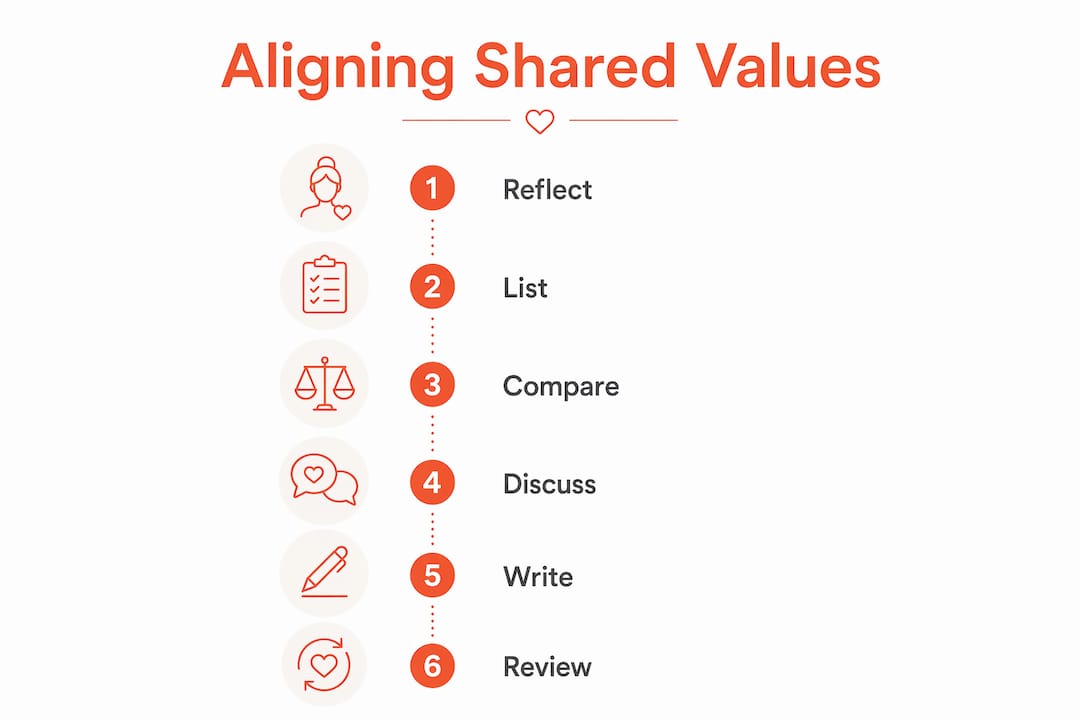
The most effective starting point for value alignment is independent reflection, not a joint conversation. When you sit down together before you have each done your own thinking, you risk drifting toward your partner's answers rather than your own. That drift produces surface agreement, not genuine alignment.
Experts recommend each partner independently lists 10 personal values, then narrows that list to the top 5 before sharing with their partner. That independent phase takes roughly 15–20 minutes per person and surfaces true priorities rather than socially acceptable ones. The goal is honesty with yourself first.
Common values to consider include trust, respect, family, personal growth, creativity, financial security, faith, adventure, health, and community. Write them down without editing yourself. Then ask: "If I had to give up all but five of these, which five would I protect?" That question cuts through the noise quickly.
- Set aside 20 minutes of uninterrupted time, ideally on separate days from your partner.
- Write your top 10–15 values without filtering or second-guessing.
- Circle the 5 that feel non-negotiable to your sense of self.
- Write one sentence explaining why each of those 5 matters to you.
- Save your list before any joint conversation begins.
Pro Tip: Do this exercise on paper, not on a shared document. Seeing your partner's answers in real time influences your own. Paper keeps the reflection genuinely independent.
How do you merge two value lists into shared relationship values?
Once both partners have their individual top 5, the real work begins. Lay both lists side by side and look for three categories: values you share exactly, values that complement each other, and values that appear to conflict.

Shared values are easy to spot. Complementary values are equally powerful and often overlooked. If one partner values structure and the other values creativity, those two orientations can work together rather than against each other. Forced uniformity in values suppresses individuality and leads to resentment. The goal is teamwork, not a merger where one person disappears.
The seven areas every couple should discuss explicitly before or early in marriage are:
- Trust: What does it look like when you feel trusted? What breaks it?
- Communication: How do you prefer to handle disagreements?
- Honesty: Where are your boundaries around full disclosure?
- Boundaries: What limits do you need with family, friends, and work?
- Religion and spirituality: How central is faith to your daily life and parenting?
- Respect: What specific behaviors make you feel respected or disrespected?
- Forgiveness: How long does it take you to process hurt, and what does repair look like?
Alignment in these seven areas is one of the strongest indicators of long-term partnership success. Working through them early prevents years of unspoken assumptions from calcifying into conflict.
After the conversation, write a shared values statement together. Keep it to three to five sentences. It should answer: "What do we stand for as a couple, and how do we want to treat each other and the world?" This statement becomes a filter for future decisions, from where you live to how you spend money to how you raise children.
Pro Tip: Build your shared statement from the smallest points of agreement first. Starting with values you both hold easily creates momentum and goodwill before you tackle the harder conversations.
| Category | Individual focus | Shared focus | | --- | --- | --- | | Trust | Personal boundaries and deal-breakers | Agreed behaviors that build safety | | Communication | Preferred conflict style | Joint rules for disagreements | | Family and faith | Background and upbringing | Shared rituals and future plans | | Growth | Personal ambitions | Mutual goals and timelines |
What does living shared values actually look like day to day?
Naming your values is the beginning, not the finish line. Daily small behaviors bring values to life far more than occasional grand gestures. A couple that values connection but never schedules time together is not living that value. Behavior is the proof.
The most practical daily commitment is a five-minute check-in. It does not need an agenda. Ask your partner one question: "What do you need from me today?" That single habit, practiced consistently, reinforces the values of respect and communication without requiring a formal meeting.
- Daily: A five-minute check-in, a specific expression of gratitude, or a brief moment of physical connection like a real hug, not a passing one.
- Weekly: A 30-minute "state of us" conversation where you each share one thing that felt good and one thing that felt off.
- Annually: A values review where you revisit your shared values statement and ask whether it still reflects who you are as a couple.
Couples who share a life direction experience less conflict around daily decisions and report stronger emotional stability. Shared direction does not mean identical schedules or identical goals. It means both partners understand where they are headed together and why.
For couples with demanding schedules or long-distance arrangements, the format matters less than the frequency. A voice message, a shared journal entry, or a two-sentence text at the end of the day all count. The ritual is the point, not the medium.
Pro Tip: Consistency beats intensity every time. A five-minute check-in every day does more for your relationship than a single four-hour conversation once a month. Put it in your calendar like any other commitment.
What are the most common pitfalls when aligning values early?
The most damaging mistake couples make is attempting value alignment conversations during or immediately after a conflict. Establishing shared values during conflict causes partners to use values as weapons rather than guides. Wait for a calm, neutral moment when both of you feel safe and unhurried.
A second hidden barrier comes from family-of-origin patterns. Family blueprints shape subconscious values in ways neither partner may recognize. Ask each other: "How did your family handle financial stress? How did they show love? What happened when someone got sick?" Those answers reveal unspoken rules that will show up in your marriage whether you name them or not.
- Avoid scheduling value conversations when either partner is tired, hungry, or emotionally activated.
- Watch for "eventually" versus "now" gaps. Timeline mismatches, not goal differences, are often the real source of conflict. One partner wants to buy a house in two years; the other assumes five. Name the timeline, not just the goal.
- Resist the urge to resolve every difference in one sitting. Some values take months of conversation to integrate.
- Recognize when you need outside support. A relationship therapist can facilitate conversations that feel too charged to navigate alone.
"Clarity about your partner's internal world builds the emotional safety you need to negotiate future conflicts. Love is not enough on its own. Understanding is what makes love sustainable."
Key Takeaways
Couples who establish shared values early in marriage build a concrete framework that reduces conflict, deepens trust, and guides every major life decision they face together.
| Point | Details | | --- | --- | | Start independently | Each partner lists their top 5 values alone before any joint conversation begins. | | Cover the seven core areas | Trust, communication, honesty, boundaries, religion, respect, and forgiveness require explicit discussion. | | Write a shared values statement | A three-to-five sentence statement gives your marriage a decision-making filter. |
Begin your practice
Build a marriage that keeps growing.
Start your first check-in tonight. Five minutes that begin a practice your marriage will thank you for.