The State of Marriage: Why Love Alone Is Not Enough
We asked 100 married people what is actually hard about staying close after “I do.” Their answers were honest, revealing, and a reminder that marriage needs more than good intentions.
Marriage rarely becomes difficult because two people suddenly stop loving each other.
More often, the strain begins quietly.
It shows up in conversations that become shorter or more transactional. In the stress of work, children, finances, caregiving, and competing priorities. In the feeling that you are managing a life together but no longer fully experiencing it together.
At Matrimo, we believe marriage deserves more proactive support. Not just when a couple reaches a breaking point, but in the ordinary, evolving moments that determine whether two people continue to feel seen, supported, and connected.
That is why we asked 100 married people to tell us what is actually hard about staying close after “I do.”
Their answers point to a truth many couples already know: love matters deeply, but love also needs systems.
Communication Is Still the Hardest Part
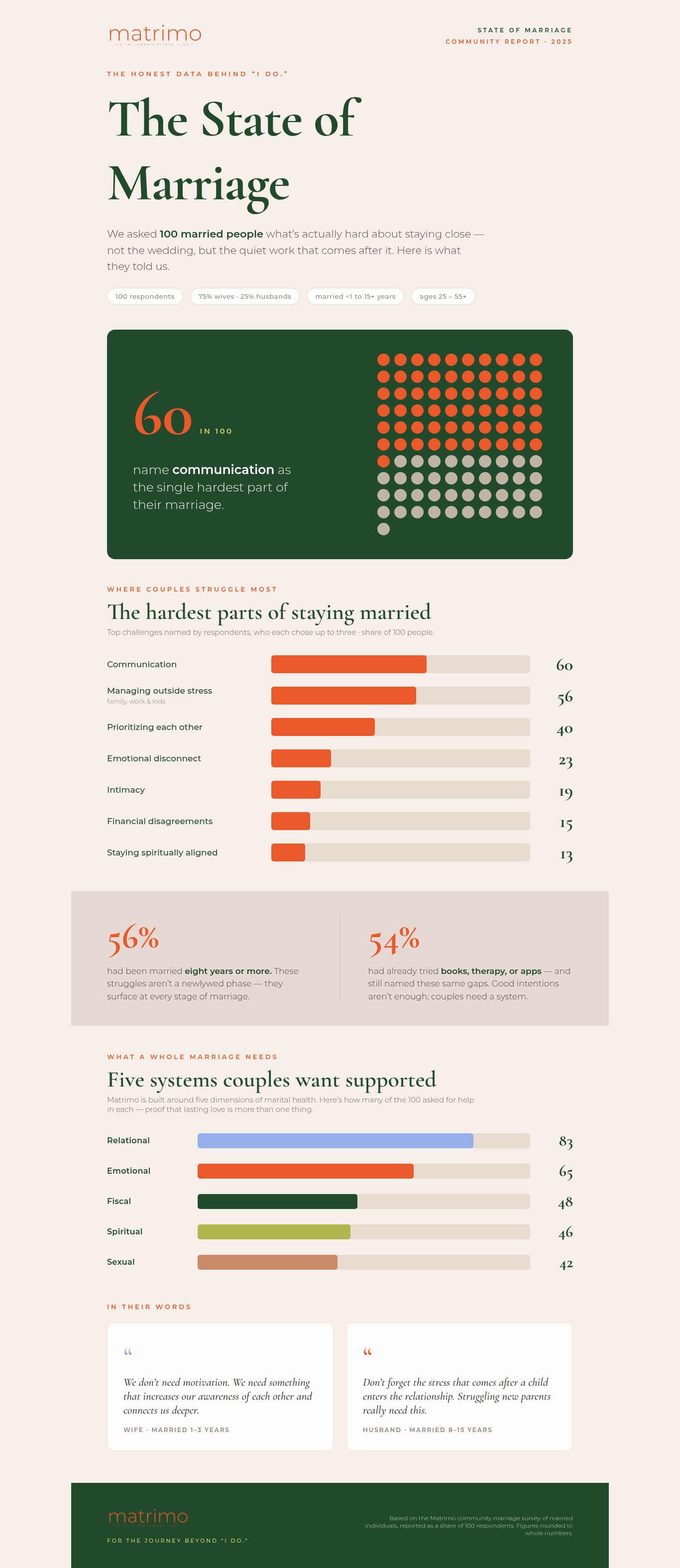
When asked about the most challenging parts of marriage, 60% of respondents named communication.
That result is not surprising, but it is significant.
Communication is often described as the foundation of a healthy relationship. Yet in marriage, it is not simply about talking more. It is about creating the conditions for honest, productive, and compassionate conversation.
It is knowing how to say, “I need more support,” before resentment builds.
It is being able to discuss finances without shame or defensiveness.
It is learning how to repair after an argument instead of allowing distance to become the new normal.
It is making room for both partners to be heard, especially when life is moving fast.
For many couples, communication becomes difficult not because they do not care, but because they have not been given a shared rhythm or language for navigating the everyday pressures of partnership.
Outside Stress Does Not Stay Outside
The second-largest challenge named by respondents was managing outside stress, including work, family, and children.
Marriage does not exist in a vacuum.
It exists alongside deadlines, bills, aging parents, career changes, health concerns, household responsibilities, parenting, grief, friendship, and all the unexpected things life brings. Even strong relationships can struggle when stress is left unnamed or carried alone.
The issue is not that couples experience stress. Every couple will.
The issue is whether they have a way to recognize how that stress is affecting their connection.
When one partner is overwhelmed, exhausted, or emotionally stretched, the relationship often becomes the place where the pressure lands. That can look like impatience, withdrawal, tension around small decisions, or a loss of intimacy.
A healthier approach is not expecting marriage to be untouched by stress. It is creating practices that help couples face stress together.
Prioritizing Each Other Is a Practice
Forty percent of respondents said prioritizing each other is one of the hardest parts of marriage.
This is where many couples can feel discouraged. They may still deeply love one another, but the relationship begins to receive whatever time, energy, or attention is left over after everything else.
The truth is that partnership requires intention.
That does not mean every week needs a grand date night or an elaborate gesture. It means couples need regular opportunities to ask:
How are we really doing?
What has felt good between us lately?
Where are we missing each other?
What do we need more of this week?
How can we make room for connection in the life we already have?
Small, repeated acts of attention can make a meaningful difference. A five-minute check-in. A shared ritual. A conversation that is not about logistics. A moment of appreciation. A decision to put the phone down and be present.
These are not minor things. They are how closeness is maintained.
Marriage Is More Than One Conversation
Our survey respondents also identified emotional disconnect, intimacy, financial disagreements, and staying spiritually aligned as important challenges.
Together, these findings reinforce what Matrimo has believed from the beginning: marriage is not one-dimensional.
A couple may be communicating well but struggling with emotional closeness.
They may feel emotionally connected but avoid conversations about money.
They may share a home and a schedule but have lost a shared sense of purpose, intimacy, or spiritual alignment.
No single date night, therapy session, budgeting tool, or relationship book can fully address the complexity of modern marriage on its own.
Couples need support across the full ecosystem of their relationship.
That includes:
Relational health: communication, connection, conflict repair, and shared rituals
Emotional health: self-awareness, emotional check-ins, empathy, and support
Fiscal health: money conversations, budgeting, shared goals, and financial alignment
Spiritual health: shared values, intention, faith practices, and meaning
Sexual health: intimacy, desire, boundaries, curiosity, and honest conversation
These are not separate parts of a marriage. They influence one another every day.
The Challenges Do Not End After the Early Years
One of the most important findings from the survey is that these struggles are not only a newlywed experience.
More than half of respondents had been married for eight years or more.
That matters because it challenges the idea that time alone solves relationship challenges. Couples do gain history, resilience, and deeper understanding over time. But they also face new seasons that require new tools.
A marriage may need different support after becoming parents, changing careers, relocating, grieving a loss, caring for family members, navigating health changes, or simply growing into new versions of yourselves.
The goal is not to avoid every difficult season.
The goal is to have a system for staying connected through them.
Good Intentions Are Not a System
More than half of respondents said they had already tried books, therapy, or apps and still identified these same gaps in their marriage.
This does not mean those resources do not have value. Therapy can be transformative. Books can provide language and insight. Apps can create helpful habits.
But the finding does reveal a broader need.
Many couples do not need more information. They need a consistent, practical way to apply what they already know.
One respondent put it beautifully:
“We don’t need motivation. We need something that increases our awareness of each other and connects us deeper.”
That is the difference between a moment of inspiration and a sustainable practice.
Marriage support should not only be available in crisis. It should be built into the rhythm of everyday life.
Why We Built Matrimo
Matrimo is an AI-powered relationship wellness platform designed to help modern couples strengthen their marriage through daily intention.
We are building a place where couples can better understand themselves, stay connected to each other, and create healthier patterns across the areas that most shape their partnership.
Not because every marriage is broken.
But because every marriage deserves support.
Not because couples need to become perfect.
But because connection is easier to maintain when it is practiced.
We believe the future of marriage support should be proactive, accessible, deeply human, and designed for real life.
Love may be the beginning.
But the habits, conversations, rituals, and systems we build around love are what help it last.
Ready to build a more connected marriage? Explore Matrimo and discover tools designed for the journey beyond “I do.”